

Latest Version
January 12, 2026
WhatsApp LLC
Communication
Android
0
Free
com.whatsapp
Report a Problem
More About WhatsApp Messenger
WhatsApp Messenger: Features, Benefits, Download & Complete Guide (2026)
WhatsApp Messenger is one of the world’s most popular instant messaging applications, used by billions of people to stay connected through messages, voice calls, video calls, and media sharing. Developed by Meta (formerly Facebook), WhatsApp offers fast, secure, and user-friendly communication across Android, iOS, Windows, and web platforms.
In this article, we’ll cover what WhatsApp Messenger is, its key features, benefits, privacy, download guide, and FAQs to help you fully understand why it dominates the messaging world.
What is WhatsApp Messenger?
WhatsApp Messenger is a free messaging app that allows users to send text messages, voice notes, images, videos, documents, and location information over the internet. Instead of using traditional SMS charges, WhatsApp uses mobile data or Wi-Fi, making it cost-effective and globally accessible.
Key Features of WhatsApp Messenger
1. Instant Messaging
Send and receive messages instantly with real-time delivery and read receipts.
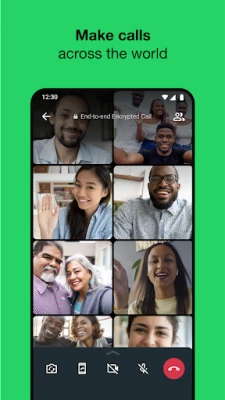
2. Voice & Video Calling
Enjoy high-quality voice calls and HD video calls, even on slow networks.
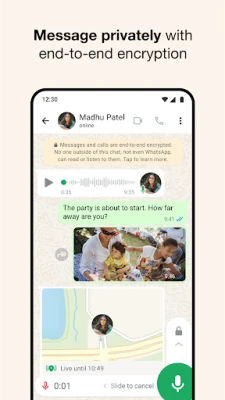
3. End-to-End Encryption
All personal messages, calls, and shared media are protected with end-to-end encryption, ensuring complete privacy.
4. Media & File Sharing
Share photos, videos, audio files, PDFs, Word files, and more (up to 2GB per file).
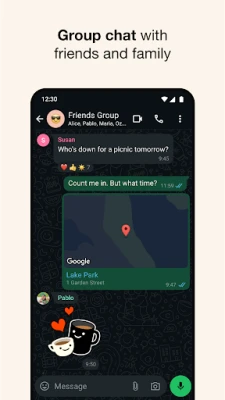
5. WhatsApp Groups & Communities
Create groups with up to 1024 members, manage communities, and broadcast announcements easily.
6. WhatsApp Status
Share text, photos, or videos as Status updates that disappear after 24 hours.
7. Multi-Device Support
Use the same WhatsApp account on multiple devices without keeping your phone connected.
8. Voice Notes & Stickers
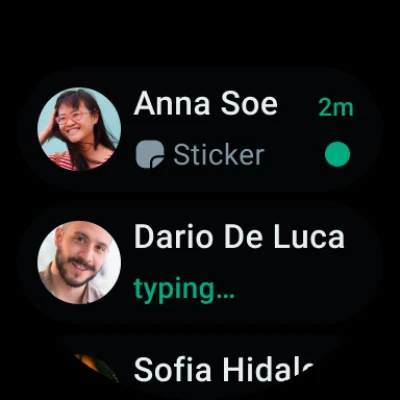
Send quick voice messages and expressive stickers for better communication.
Benefits of Using WhatsApp Messenger
✅ Free and fast communication
✅ Works worldwide
✅ Secure and private chats
✅ Simple and clean interface
✅ Low data usage
✅ No ads in personal chats
✅ Free and fast communication
✅ Works worldwide
✅ Secure and private chats
✅ Simple and clean interface
✅ Low data usage
✅ No ads in personal chats
WhatsApp Messenger Privacy & Security
WhatsApp takes privacy seriously by offering:
End-to-end encryption by default
Two-step verification
Biometric app lock (fingerprint / Face ID)
Chat lock & disappearing messages
Control over last seen, profile photo, and status visibility
How to Download WhatsApp Messenger
For Android
Open Google Play Store
Search for WhatsApp Messenger
Tap Install
Open Google Play Store
Search for WhatsApp Messenger
Tap Install
For iPhone
Open App Store
Search WhatsApp Messenger
Tap Get
Open App Store
Search WhatsApp Messenger
Tap Get
For PC / Web
Use WhatsApp Web or download WhatsApp Desktop from the official site
Use WhatsApp Web or download WhatsApp Desktop from the official site
WhatsApp Messenger for Business
WhatsApp also offers WhatsApp Business, designed for small and large businesses to:
Communicate with customers
Create business profiles
Use automated replies
Build customer trust
Frequently Asked Questions (FAQs)
Is WhatsApp Messenger free?
Yes, WhatsApp is completely free to use. Only internet charges may apply.
Is WhatsApp safe to use?
Yes. WhatsApp uses end-to-end encryption, making conversations secure.
Can I use WhatsApp without a SIM?
You need a phone number for registration, but afterward you can use it on multiple devices.
Does WhatsApp work internationally?
Yes, WhatsApp works worldwide as long as you have internet access.
Final Thoughts
WhatsApp Messenger remains the #1 choice for personal and business communication due to its speed, simplicity, security, and powerful features. Whether you want to chat with friends, make video calls, share files, or run a business, WhatsApp is an all-in-one messaging solution.
If you’re looking for a reliable, secure, and easy-to-use messaging app, WhatsApp Messenger is the best option in 2026.
WhatsApp Messenger 2026 “Big Update” in India: Features, Rules, Business Changes (Deep Research)
WhatsApp 2026 India update: new group chat tools (Member Tags, Text Stickers, Event Reminders), upcoming SIM-binding + 6-hour WhatsApp Web logout rules, Business Platform pricing changes (per-message), and what it means for users & businesses.
1) The biggest product update users will notice: Group Chats get smarter (Jan 2026)
WhatsApp kicked off 2026 with major group chat upgrades focused on organization and expression:
Member Tags: label people in a group with custom tags/roles (useful for families, teams, classes). (WhatsApp.com)
Text Stickers: turn words into sticker-style visuals for faster, fun replies. (WhatsApp.com)
Event Reminders: create events inside groups and set reminders so people don’t miss plans. (WhatsApp.com)
Why it matters in India: WhatsApp groups are the default for coaching batches, family coordination, community updates, and micro-business customer groups—so these tools directly improve daily planning.
2) The biggest India-specific change: SIM-binding + WhatsApp Web auto logout (policy-driven, early 2026 impact)
Multiple reports and documents indicate India’s Department of Telecommunications (DoT) introduced directions under Telecommunication Cyber Security (TCS) Amendment Rules, 2025, affecting messaging apps that use mobile numbers as identifiers.
What’s being reported/outlined
SIM binding: accounts should remain linked to an active SIM used for the service. (MEDIANAMA)
WhatsApp Web / Desktop sessions auto-logout: web sessions must log out periodically (reported as within 6 hours) and require re-link/login (often via QR). (The Indian Express)
Official PDFs and explainers describe the policy direction as telecom-cybersecurity focused. (Sanchar Saathi)
Who will feel it most
People who rely heavily on WhatsApp Web/Desktop (students, office users, customer support teams).
Users who swap SIMs often (travelers, dual-SIM users, people changing numbers).
Small businesses running WhatsApp from shared desktops or multi-agent setups.
Note: The exact enforcement details and rollout behavior can vary by implementation and updates—so watch WhatsApp’s in-app notices and official DoT communications closely. (Sanchar Saathi)
3) Business “big update” in 2026: WhatsApp Business Platform pricing + cost planning in India
WhatsApp’s Business Platform moved to per-message pricing effective July 1, 2025 (a structural change that carries into 2026). (WhatsApp Business)
What changed (high level)
Billing is per delivered message (instead of older conversation-based structures), and pricing varies by message category (Marketing, Utility, Authentication, etc.). (WhatsApp Business)
Why 2026 matters
Industry trackers and providers widely report India rate revisions effective Jan 1, 2026, especially for Marketing messages (commonly cited around ₹0.8631 per message), while Utility/Authentication are much lower. For exact rates, always verify in Meta’s official pricing documentation for your country and category. (Facebook for Developers)
Practical impact for Indian businesses
Marketing blasts get more expensive → better targeting and opt-in quality become essential.
Utility + Authentication remain cost-efficient → order updates, OTPs, service alerts stay strong use-cases.
You’ll need better message governance: template category correctness, frequency control, and segmentation.
4) Another India 2026 business headline: Local billing planned (H2 2026)
A major business-facing development reported for India: WhatsApp is planning local billing for business users in India (and Brazil) in the second half of 2026, aimed at reducing FX friction and improving settlements. (The Economic Times)
5) WhatsApp as an “infrastructure layer” in India: Government services via WhatsApp
Indian states are increasingly using WhatsApp as a delivery channel. Example: Tamil Nadu launched a WhatsApp chatbot enabling citizens to access dozens of government services through chat. (The Times of India)
This signals a broader 2026 trend: WhatsApp isn’t just messaging—it's becoming an interface for services.
6) What you should do now (quick checklist)
For normal users
Keep WhatsApp updated (Play Store/App Store).
If you depend on WhatsApp Web: be prepared for more frequent re-logins if the 6-hour session rule is enforced. (The Indian Express)
Enable strong security: 2-step verification, device hygiene, and review linked devices.
For businesses
Re-audit messaging strategy:
Push promos only to high-intent segments
Shift more communication to Utility (where appropriate)
Prepare operations for possible SIM-binding/desktop session limits (agent workflows, device policies). (MEDIANAMA)
Watch for local billing announcements if you run WhatsApp Business Platform at scale. (The Economic Times)
Rate the App
User Reviews
Popular Apps